Hamnet
(but not that one)

Dead Centre, 2019
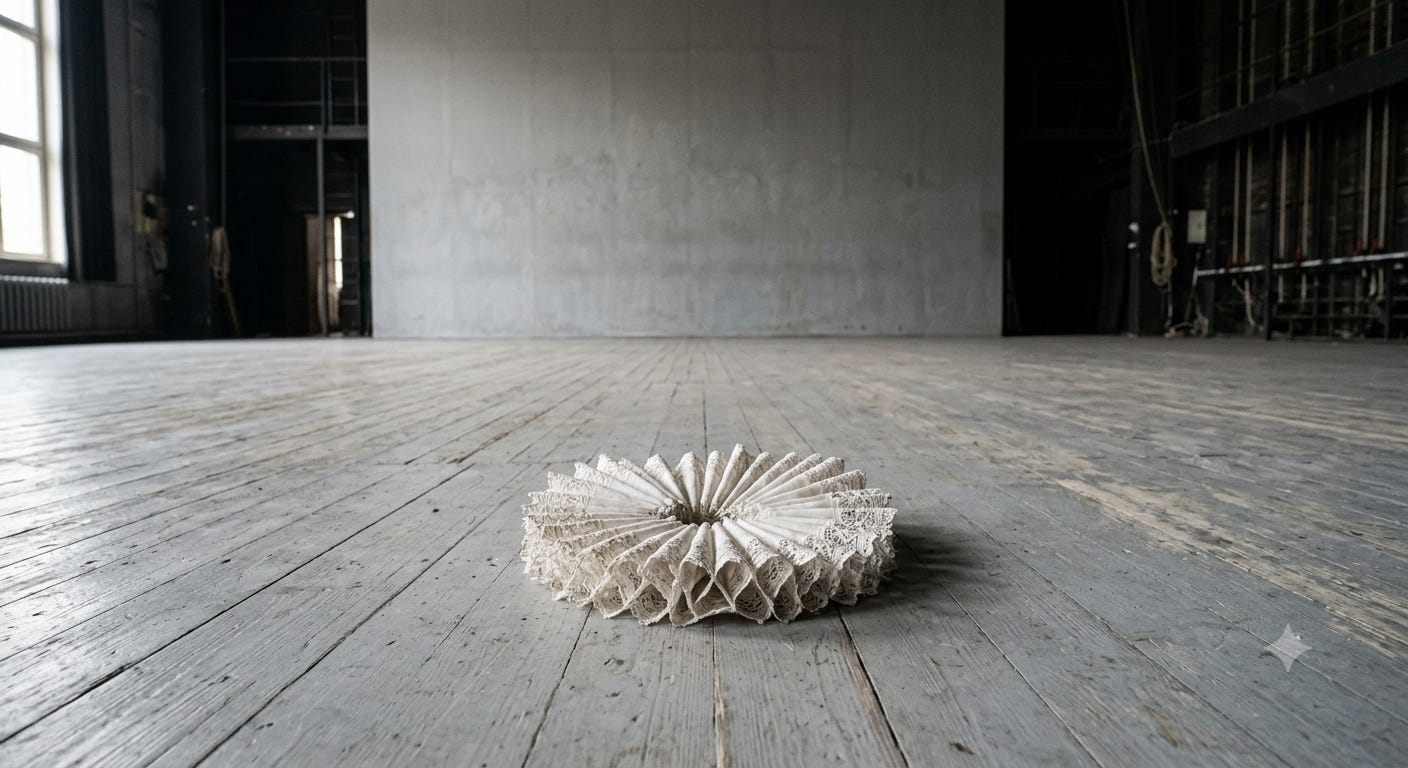
In 2019, myself and a friend congratulated ourselves on being able to score tickets to the last show of Dead Centre’s Hamnet run at the Brooklyn Academy of Music (there was a reason for our good luck, as it turns out: it was Marathon Sunday and the theatre was less than a block from the path of the runners). It was worth the inconvenience to watch this extraordinary, devised work that embodied the feeling of being inside an imaginative space, caught in a moment of emotion, while life runs forward just on the other side of the wall. Hamnet was a nonlinear, emotional experience of grief in which the eleven year old Hamnet existed in a netherworld between our contemporary space and his past, negotiating his feelings of abandonment with the ghost of his father. Unlike the 2026 movie based on Maggie O’Farrell’s exquisite book, Hamnet did not propose that great art necessarily comes from great pain. Sometimes, Dead Centre’s piece suggested, the rest is simply silence.
The fascination with Shakespeare’s life is one that has continued apace with his cultural impact, from the very moment Ben Jonson’s 1623 panegyric labeled him the “sweet swan of Avon” in juxtaposition to Robert Greene’s slightly less generous “upstart crow” in 1592, inviting us to ponder what we actually know about the playwright. Questions about Shakespeare abound. What little we know about his life - he was the father to three children, most notably a son who died young, he lived quietly, returning to Stratford-upon-Avon at the close of his career, and left his “second-best bed” to his wife Anne - does not tell us how he felt, or what inspired him, or what mattered to him. In the empty space that William Shakespeare leaves us, all we have is some deeply unstable texts that invite speculation about why he might have written them.
That he was, above and beyond, a journeyman who wrote his plays as craft and did not appear to have retained any sense of ownership over them, does not gel with modern notions of authorship. The post-Romantic ideal of a writer putting the emotions that his heart cannot contain into his language is seductive, particularly in the shadows of a mountain of iambic pentameter, so our culture continues to imagine answers to these questions we have about his life. The loss of a child, unimaginable and profoundly altering as it doubtless must be, combined with the near-overlap of the names from Hamnet to Hamlet, is almost irresistible in its promise to unlock the secrets of his most iconic play. It offers the opportunity to humanize the man behind the bland, impassive face and the unimpressive hairline in the Droeshout engraving and turn him into the man of feeling that the plays suggest he was. The conflation of Hamnet and Hamlet threatens to unlock an ocean of passion behind those disinterested eyes, and perhaps even an affirmation that he cared as much about the young Danish prince as we do.
Although the blurb of the play (both on its website and in its printed script) declares that “grief fills the room up of my absent child” (King John, 3.4.95), William Shakespeare’s experience was less important to the play’s dramaturgy and, because Dead Centre cast the extraordinary young actor Aran Murphy (actor Cillian’s son) as Hamnet, less compelling as its emotional core. Although he was genuine in his feeling, it wass harder to sympathize with a grieving father when his son was standing in front of the audience, the spectacle of which invited us to “Look at that child up there. So young. So vulnerable.” Dead Center’s Hamnet, like O’Farrell’s book, declined to value Shakespeare’s suffering the most, and instead focused on those he left behind - in this case, a small boy, dressed “in a t shirt, hoody, trainers, wearing a backpack”. Dead Centre’s Hamnet carved a path that O’Farrell would follow by telling the story of those who lived with the writer - or simply “his father” as the play’s cast list recognized him - and wonders who the human was to them.
The setting of the play was “a hellmouth,” that was, in reality, a benign white theatre box, in which “the audience enter and see themselves - a live feed projected onto a back wall” (9). It was a place where ghosts, death, life, and art are interchangeable. A place where Hamlet was the son of Shakespeare, and Hamnet was the forgotten shadow that lurks behind the literature, unable to meaningfully connect with his father or lay a claim to his greatest construction as a means of ensuring that his own memory will endure. Throughout the piece, Hamnet continually plays Hamlet, with a ruff and a skull, to try and secure his father’s interest - these tactics always failed. In Hamnet, Hamlet was not a play that justifies or explains the suffering of the man Shakespeare, but instead was a tool for condemnation, an indictment of how little Hamnet knew about his father. He chased the knowledge of his famous parent in the same way that modern Bardophiles might, scouring the text for clues of the man’s humanity and priorities. His father was a ghost, making demands on him and offering little to no clarity on why they are both caught in limbo at the hellmouth, evoking Hamlet in the same breath as refuting it At one point, when the boy appeared in front of his father in a ruff, holding a skull, the father irritably retorted, “I told you no one is Hamlet” (38) dismissing any easy correlation between the lost son and the suffering prince that would have made the father real in any meaningful way.
In Hamnet, Hamnet was stuck at eleven years old, and could not understand why. He was a modern child, who sporadically used google and his cellphone throughout the show’s 60 minutes, but his father was a man of the Elizabethan era, clearly indicated by his costume, and they both drifted in and out of whatever reality the other inhabited. The boy’s relationship with his father was almost always divided by the transparent theatrical wall on the back of the stage that intermittently put either Hamnet or his father on one side or another.
Even when they shared “real” space, they continued to inhabit their own spheres, asking questions that have no answer, alternating between longing, sadness, resentment, and confusion. Although they both longed to connect to one another, neither could let go of their own pain enough to see how they haunted each other. Hamnet was forever frozen as a child, and even though he understood his father’s greatness, and he had the luxury of the full history of the world at his fingertips on his phone, he could only understand his father through his own loneliness. When he appraised his father for the first time, he responded as the abandoned child that he was:
Hamnet: I thought you were supposed to be a great man.
Shakespeare: I am.
Hamnet: You just look like a man.
Shakespeare. You can be both.
Hamnet. Oh.
Pause
Shakespeare: I’ll prove my greatness to you. Ask me anything.
Hamnet: Why did you go away? (27)
By casting such a young child in the production, Dead Centre and Murphy made Hamnet’s scattered, uneven suffering a compelling childlike confusion. The production both recognized Will Shakespeare’s pain and condemned him for it, putting his experience to that of his son. In the intimacy of BAM’s Fisher studio space, the man seemed much less relevant than the son who hovered on the precipice of the hellmouth, trying to understand why the world was moving ahead and he was staying in the theatrical overlap between two worlds.
The reality - that Shakespeare might not have been a good father or husband was one that can be resisted if we believe that Hamlet meant something to the man, that it was a way of articulating or managing his grief, as O’Farrell’s novel suggests and the 2026 movie made explicit. Allowing us to pity him makes Hamlet feel more meaningfully connected to the construction of the author and avoids the implication that the iconic Bard of Avon might have been, at best, a mediocre human being in the lives of those who loved him. Like Hamlet’s uncertainty and the interminability of grief, we are left with questions, and our own ameliorative speculations. In the Dead Centre’s afterworld, no such comforting certainty was allowed. At the close of the play, as both Hamnet and his father drifted away, the audience was left staring at its own reflections, confronted with the fictions or theatre it created to ascribe meaning to inconceivable losses and the shadows of people we never knew to begin with.
A brief trailer for Hamnet is available on YouTube and can be viewed here.